
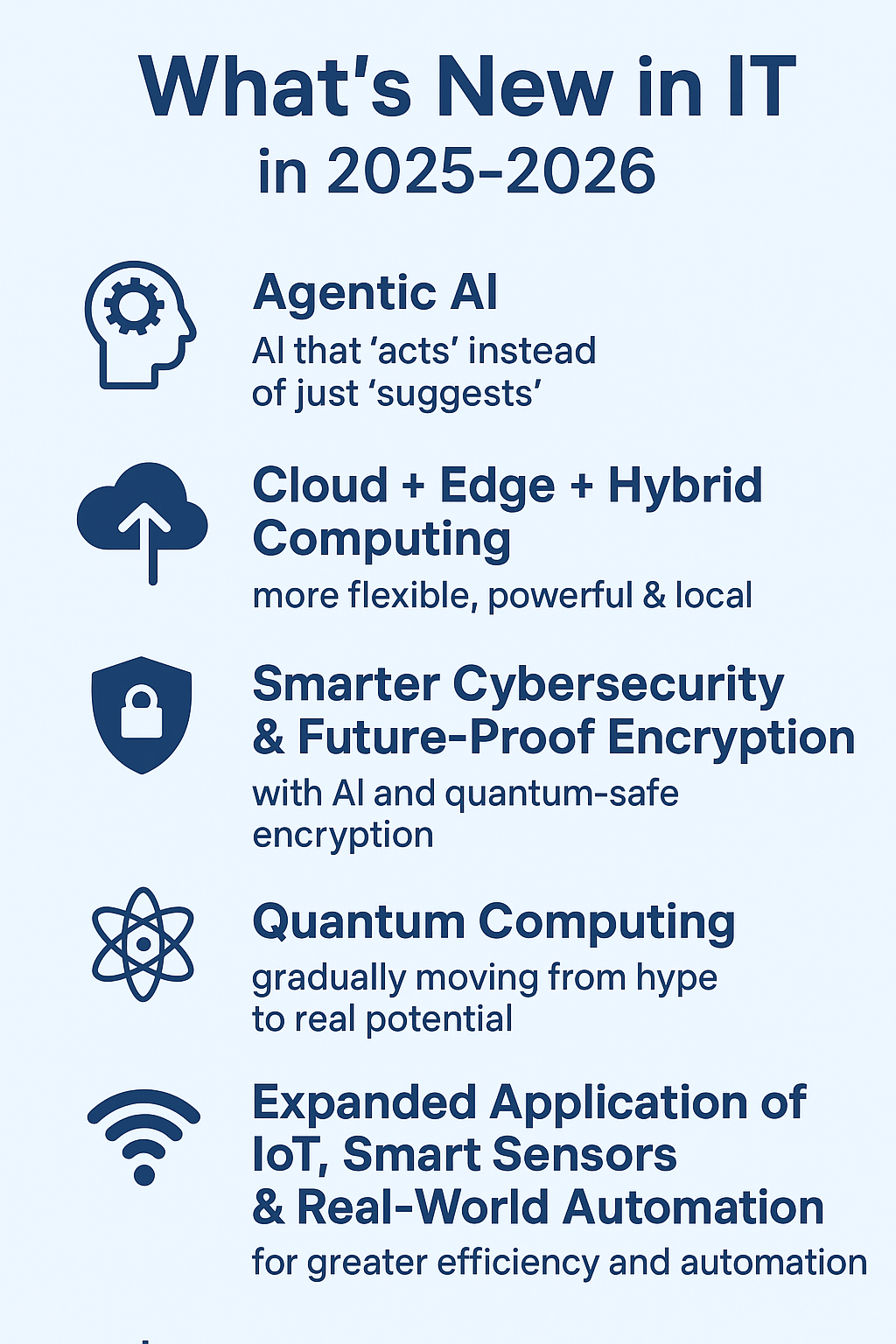
What’s new in IT in 2025–2026
• Agentic AI — AI that “acts” instead of just “suggests”
Unlike older AI tools that only respond to prompts, Agentic AI can take action: plan workflows, perform multi-step tasks, coordinate between different systems. For example, an AI agent might check your calendar, generate a quote, schedule jobs – all automatically. This makes AI more like a “digital coworker” than a tool. McKinsey & Company+2Technology Magazine+2
This evolution means IT isn’t just about automation — it’s about delegation: letting AI handle repetitive and time-consuming tasks, while your team focuses on high-value work.
• Cloud + Edge + Hybrid Computing: more flexible, powerful & local
Cloud computing remains central — but modern deployments are mixing cloud with “edge computing” (processing data closer to where it’s generated) and hybrid infrastructures (on-premises + cloud). itbcpro.ca+2elantis.com+2
For businesses, this means faster performance, reduced latency (important for real-time tasks like VoIP, remote access, IoT sensors), and better resilience. Especially useful for offices, remote workers, or businesses handling sensitive data.
• Smarter Cybersecurity & Future-Proof Encryption
With greater digital adoption comes increased cyber-risk. The newest security tools use AI to detect abnormal behaviour or potential breaches in real time. elantis.com+2arXiv+2
At the same time, the industry is preparing for future threats — such as quantum computing — by developing stronger, “quantum-safe” encryption. Technology Magazine+1
• Quantum Computing — gradually moving from hype to real potential
Quantum computing remains largely at an advanced research stage — but 2025 onwards marks a phase where its potential starts becoming more concrete. Some use cases (complex simulations, optimization, cryptography) begin to move closer to being practical. 247Labs+1
For businesses with complex computational needs (logistics, data analysis, optimization, security), quantum advances could represent a major leap.
• Expanded Application of IoT, Smart Sensors & Real-World Automation
More businesses now use IoT and sensor-based solutions — linked to cloud or edge computing — to automate tasks like monitoring, predictive maintenance, resource management (energy, production, devices). Technology+2itbcpro.ca+2
This reduces overhead, improves efficiency, and supports remote or hybrid working models.
• Better Human–Machine Collaboration & Immersive Experiences
New technology is closing the gap between humans and machines — through more intuitive interfaces, multimodal input, and immersive environments. Think voice- or gesture-driven tools, augmented/virtual reality (AR/VR), and dynamic collaboration platforms. Technology Magazine+1
These advances help staff work more naturally, make complex tasks easier, and open up new service/product opportunities.
✅ What it means for small / medium businesses like yours
-
You don’t need to be a giant company to benefit — many of these technologies (cloud, AI, security, IoT) are now accessible and scalable for small business budgets.
-
You can automate and streamline not just repetitive tasks, but complex workflows and multi-step processes (thanks to agentic AI).
-
You can future-proof your business: better security, modern infrastructure, readiness for quantum-era challenges or IoT growth.
-
You can offer modern services and increased reliability — which becomes a selling point when clients expect “digital-first” experience.

